Pastéis de Nata: Authentic Portuguese Custard Tarts
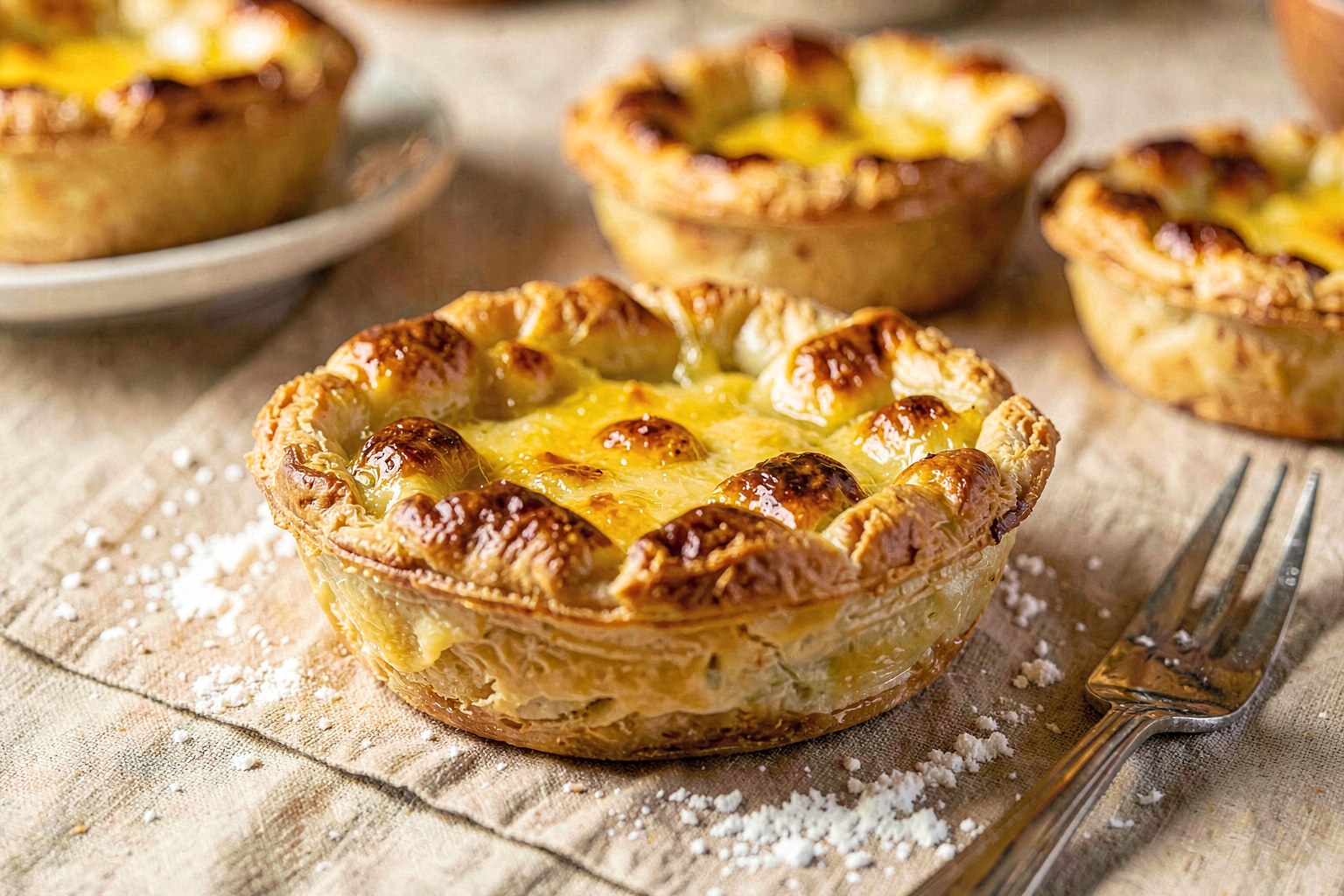
These iconic tarts feature a blistered, caramelized egg custard filling nestled in a shatteringly crisp, flaky puff pastry shell. The flavor is intensely rich and creamy with a hint of burnt sugar, traditionally finished with a dusting of cinnamon and powdered sugar.
A little context
Originating in the 18th century at the Jerónimos Monastery in Belém, Lisbon, these tarts were created by monks who needed to use up excess egg yolks left over from starching their habits. After the 1820 revolution, the recipe was sold to a sugar refinery, and the 'Fábrica de Pastéis de Belém' has guarded the original formula ever since. While variations exist across Portugal, the authentic Belém style requires a specific sugar syrup technique and is served warm, often with a sprinkle of cinnamon and powdered sugar.
Method
- 01
Prepare the dough
In a stand mixer, combine 500g flour, 150ml water, 15g salt, and the 200g cubed cold butter. Mix on low until a shaggy dough forms. Turn out onto a floured surface and knead gently just until smooth. Wrap tightly and refrigerate for 30 minutes.
- 02
Create the butter block
While the dough chills, place the remaining 200g butter block between two sheets of parchment paper. Pound and roll it into a rough 15cm x 15cm square. Keep it cold but pliable.
- 03
First fold
Roll the chilled dough into a 30cm x 20cm rectangle. Place the butter block in the center and fold the dough over it like an envelope. Seal the edges. Roll the packet out to a 60cm x 20cm rectangle. Fold the dough into thirds (letter fold). Wrap and chill for 30 minutes.
- 04
Complete the lamination
Repeat the rolling and folding process two more times, chilling for 30 minutes between each turn. After the final fold, roll the dough out into a long, thin rectangle roughly 5mm thick. Roll it up tightly like a Swiss roll and wrap in plastic. Freeze for at least 2 hours (or overnight) until firm.
- 05
Make the sugar syrup
In a small saucepan, combine 100g sugar, 60ml water, the cinnamon stick, and the lemon peel. Bring to a boil, stirring until sugar dissolves. Boil without stirring until it reaches 115°C (239°F) on a candy thermometer. Remove from heat, remove the cinnamon and lemon, and let cool completely.
- 06
Prepare the custard base
In a saucepan, whisk together the heavy cream, milk, and the cooled sugar syrup. Bring to a gentle simmer. In a separate bowl, whisk the 5 egg yolks with the 15g flour until smooth. Temper the yolks by slowly adding half the hot cream mixture while whisking constantly. Pour the yolk mixture back into the saucepan.
- 07
Thicken the custard
Cook over low heat, whisking constantly, until the mixture thickens enough to coat the back of a spoon (about 82-85°C / 180-185°F). Do not boil. Strain immediately through a fine-mesh sieve into a clean bowl. Cover with plastic wrap touching the surface to prevent a skin from forming. Cool to room temperature, then chill until cold.
- 08
Shape the tarts
Preheat the oven to its highest setting (250°C / 480°F) with a rack in the upper third. Take the frozen dough roll and cut it into 12 equal slices (about 2.5cm thick). Place each slice cut-side up into the greased metal tart molds. Press the dough up the sides and over the rim, leaving a small lip.
- 09
Fill and bake
Fill each mold with the chilled custard, stopping about 3-4mm below the rim. Bake for 10-12 minutes. The tops should be deeply caramelized and spotty brown, and the pastry should be puffed and crisp. Keep a close eye to prevent burning.
- 10
Cool and serve
Let the tarts cool in the tin for 5 minutes, then transfer to a wire rack. Dust generously with ground cinnamon and powdered sugar just before serving. They are best eaten warm.
Pro tips
- ✦Keep everything cold: If the butter melts during lamination, the layers will fuse and you won't get the signature shatter.
- ✦Use a candy thermometer: The sugar syrup must reach exactly 115°C to achieve the correct texture; visual cues are unreliable.
- ✦Cut the dough with a sharp knife: A sawing motion will crush the layers and prevent rising.
- ✦Bake at maximum heat: The intense heat is required to puff the pastry rapidly before the custard sets.
- ✦Don't skip the lemon peel: It provides the subtle, authentic citrus note that balances the rich egg and sugar.
Shop this recipe
As an Amazon Associate we earn from qualifying purchases.
Substitutions
- all-purpose flour (for dough) → bread flour (higher protein creates stronger gluten structure for better lamination)
- metal tart molds → standard muffin tin (result will be taller and less traditional; lower oven temp slightly to prevent burning)
- whole milk → half-and-half (makes the custard slightly richer but may alter the set)
Storage
Best eaten fresh on the day of baking. Can be stored in an airtight container at room temperature for up to 24 hours. Reheat in a 200°C (400°F) oven for 3-5 minutes to restore crispness. Do not freeze once baked.
What to serve with it
- Black coffee (Bica)
- Port wine (Tawny)
- Strong espresso
- Green tea
FAQ
Why did my tarts not puff up?+
The butter likely melted during the lamination process, or the oven wasn't hot enough. Ensure the dough is cold before baking and use the highest possible oven temperature.
Can I use store-bought puff pastry?+
You can, but it will be difficult to shape into the specific low-walled, fluted molds. The texture will also be different. If using, look for 'all-butter' puff pastry and roll it thinner before cutting.
The custard is too runny.+
Ensure the egg yolk mixture was cooked to 82-85°C (180-185°F). If it didn't reach this temperature, the starch won't activate fully. It will thicken slightly as it cools.